Why a Wind Flag Belongs on Every Steel Gong Target Setup
Why a Wind Flag Belongs on Every Steel
Gong Target Setup
There is one item that competitive long range shooters have used for decades that almost never shows up at a casual range day, even when it absolutely should. It’s inexpensive and sets up in seconds. It answers one of the most common questions every shooter asks when they miss a shot at distance: was that me, or was that the wind?
We are talking about the wind flag. And if you are shooting steel gong targets at rifle distances, which for AR500 steel means 200 yards and beyond, a wind flag mounted downrange is not a luxury item for serious competitors. It is a practical tool that makes every range session more informative, intentional, productive.
This post will explain exactly why wind matters when you are shooting steel gong targets, what is happening to your bullet between the muzzle and the plate, why the wind at your shooting position is often not the wind your bullet is fighting, and how to read a wind flag correctly so that you can use what you see to put more rounds on steel. We will also talk about how to integrate a wind flag into a portable steel target setup so it travels with your system and is always ready when you are.
What Wind Does to a Bullet in Flight
Before we talk about flags and how to read them, it is worth understanding the physics of what wind does to a projectile in flight. This is not a complicated concept, but a clear model that will change the way you think about missed shots at distance.
When you fire a bullet from a rifle, it leaves the muzzle traveling in the direction you aimed it. What happens after that is a function of gravity, air resistance, and any lateral force acting on the bullet during its flight. Wind is that lateral force. A crosswind pushing from your left or right side is continuously deflecting the bullet away from its original path for the entire duration of its flight time.
The word "continuously" is the important one. Wind drift is not a single event that happens at impact. It is an accumulation of small deflections over the entire arc of the bullet's flight, from the moment it leaves the barrel until it either hits the target or falls to the ground. This means that the longer the bullet is in the air, the more total deflection accumulates. Distance and flight time are the multipliers that turn a manageable 10 mph crosswind into a shot that rings the edge of your gong instead of the center.
The amount of wind drift a given bullet experiences depends on three factors: wind speed, flight time, and the bullet's ballistic coefficient. A bullet with a high ballistic coefficient cuts through the air more efficiently and drifts less in a given wind than a low BC bullet fired at the same velocity from the same distance. This is a significant part of why cartridges like 6.5 Creedmoor have become so popular for longer range steel shooting. The high BC bullets available in that caliber maintain velocity better and drift less than comparable cartridges with lower BC projectiles.
A practical example illustrates the scale of this. A standard 168 grain .308 Winchester load fired at 2,600 feet per second will drift approximately 7 to 8 inches in a 10 mph full value crosswind at 300 yards. On an 18 inch steel gong target, that drift puts your hit near the edge of the plate. On a 12 inch gong, that same 10 mph wind moves your bullet from the center to a miss. At 500 yards, the same round drifts over 20 inches in that same 10 mph wind. Understanding this gives you context for why knowing what the wind is actually doing downrange is not academic. It is the difference between ringing the steel and wondering where your shot went.
Why the Wind at Your Firing Position Is Not the Wind That
Matters
Here is the part that surprises most casual steel target shooters. The wind you feel standing at the firing line is often not the wind your bullet is flying through. Terrain, vegetation, structures, and the three-dimensional geometry of moving air mean that wind conditions can vary dramatically between where you are standing and where your steel target is hanging.
Think about how that plays out on a typical field shooting setup in the kind of terrain where portable steel gong targets get used most: open grassland, hillsides, desert terrain, the edge of a tree line. You set up your firing position in the partial shelter of a truck or a rise in the ground. You feel a light breeze, maybe 5 mph, at your position. A hundred and fifty yards away your steel gong is sitting in a gap in the landscape where the terrain channels the same air mass into a 12 mph crosswind. You fire a shot that your body tells you should ring the center of the gong. The bullet drifts 10 inches right and misses. You have no idea why.
This scenario is not unusual. It is actually the norm whenever you are shooting at distances over 100 yards in open terrain with any variation in ground features. The wind at your face is data about one small point in space. The wind at your target is data about an entirely different point, which is the point that matters for your bullet's final deflection.
A downrange wind flag solves this problem. Mounted at or near the target, it shows you what the air is actually doing at the location where your bullet is arriving. When you see the flag moving and can estimate its speed and direction from the firing line, you have actionable information about the actual wind condition your bullet is flying into. That information is what allows you to make a wind call, which is the adjustment you hold into the wind before pulling the trigger.
Understanding Wind Direction: Full Value, Half Value, and
No Value
Not all wind directions affect your bullet equally, and understanding the relationship between wind direction and its effect on a shot is fundamental to reading a wind flag usefully.
Competitive precision shooters use a straightforward framework for this that translates to gong shooting at rifle distances. Wind direction is described relative to the line from shooter to target, and its effect on bullet drift is described in terms of value.
A full value wind is one blowing perpendicular to the line of fire, at 90 degrees relative to the direction you are shooting. This is a pure crosswind, and it has the maximum effect on your bullet's lateral drift. The drift numbers used in the earlier .308 example are full value wind drift numbers. A 10 mph full value wind gives you the complete 7 to 8 inches of drift at 300 yards.
A half value wind is one blowing at roughly 45 degrees to the line of fire, coming from one of the diagonal angles. Because only part of that wind's force is pushing your bullet sideways and the rest is pushing it forward or backward along its path, a 45-degree wind produces approximately half the lateral drift of a full value crosswind at the same speed. A 10 mph wind at 45 degrees gives you roughly 3 to 4 inches of drift at 300 yards with that same .308 load, not 7 to 8.
A no value wind is one blowing directly toward you or directly away from you along the line of fire. A pure headwind or tailwind affects bullet velocity slightly but produces essentially zero lateral drift. This is the only wind condition where you can call zero windage and not be holding off into empty space.
When you look at a wind flag, you are reading two things simultaneously: wind speed from how much the flag is moving, and wind direction from which way the flag is pointing. Combining those two readings gives you the complete picture of how much wind correction to apply and in which direction. Once you practice this a handful of times, the mental process becomes fast and intuitive. It never becomes irrelevant, because the wind does not stop changing.
How to Read Wind Speed from a Flag
The mechanical way a wind flag indicates speed is simple and reliable. The flag will hang at some angle between completely limp and fully extended, and that angle is a direct function of the wind speed acting on it.
A flag that is hanging limply with occasional gentle movement indicates very light wind in the range of 0 to 3 mph. At this speed, wind drift at typical steel gong ranges is small enough to essentially ignore for most rifle calibers. You can see the flag just barely stirring, and you know the wind is not a meaningful variable in your shot.
A flag that is moving actively but not fully extended, hanging at roughly 15 to 30 degrees off the stand, indicates a light to moderate wind in the range of 5 to 8 mph. At this speed, wind correction starts to matter at rifle distances beyond 200 yards and matters quite a bit at 300 yards and beyond. A 5 mph full value crosswind moves that .308 bullet about 4 inches at 300 yards, and 4 inches at 300 yards is often a miss on smaller gong targets.
A flag flying at roughly 45 degrees off the stand is the benchmark most shooters use as a reference point, and it corresponds to approximately 10 mph of wind. This is not a precise formula but it is a practical and widely used approximation. When you see a 45-degree flag, call it 10 mph, figure out its direction relative to your line of fire, apply the full or half value adjustment for that direction, and hold accordingly.
A flag that is fully extended or nearly so, flying nearly horizontal from the stand, indicates a strong wind in the range of 15 to 20 mph or above. At these wind speeds, wind drift at rifle distances becomes significant enough to require substantial holds, and conditions this strong are also often gusty rather than steady, which adds the challenge of timing your shots to lulls in the wind rather than guessing at the average.
That last point about gusty versus steady wind is thinking about. A steady 10 mph wind is actually easier to shoot in than a wind that varies between 2 mph and 15 mph in unpredictable gusts. With a steady wind you make one correction and hold it. With variable wind you need to watch the flag constantly, wait for a lull or a predictable condition, and fire in that window. The flag tells you both what the wind is doing right now and how consistent it has been, because you can watch its behavior over the course of a few minutes before you fire.
Why a Flag at the Target Tells You More Than a Flag at the
Firing Line
Some precision shooting ranges, like those set up for benchrest or F-Class competition, post multiple wind flags along the entire length of the range from firing line to target. This is because in high-stakes competition, shooters want to know not just the wind at the target but the wind at every point along the bullet's flight path, since the midrange wind has more influence on final drift than the wind immediately before impact.
For a portable steel gong target setup being used for recreational rifle shooting and practical training, this level of information is both unnecessary and impractical to set up. The single most actionable data point you can have is the wind at the target, because that is where your bullet is arriving and that is the condition that determines your last several yards of drift. A flag at the target gives you the information that directly predicts your hit or miss outcome, and it does so in a way you can see from the firing line.
The other reason a flag at the target outperforms a flag at the firing line is that terrain features between you and the target affect the two locations differently. If your shooting position is more sheltered than your target, the flag at the firing line will show you less wind than is actually acting on your bullet at arrival. If your target is sitting in an open field while you are shooting from the shelter of a hillside, the mismatch between firing line conditions and target conditions is dramatic. The only way to get accurate information about what your bullet is actually flying into is to have the flag at the target.
The Practical Value for Steel Gong Shooting Specifically
Every point made so far about wind reading is more typically discussed in the context of
precision rifle competition or hunting preparation. It is worth being direct about how all of it applies specifically to shooting steel gong targets at recreational rifle distances, because the practical payoff is real even when the stakes are not a competition or a hunt.
When you miss a steel gong at 200 or 300 yards, you generally have one of two problems. Either you made a shooter error: a trigger pull issue, a flinch, a sight picture problem or the wind moved your bullet off the plate and you had no idea it was going to. These two causes have completely different solutions. Shooter error needs to be identified and corrected through deliberate practice. Wind drift needs to be compensated for through a wind call and a hold adjustment. Solving shooter error when the real problem was wind, or blaming wind when the real problem was your trigger, both lead you in the wrong direction.
A wind flag at the target gives you the context to distinguish between these two causes in real time. When you pull the trigger on a clean shot and hear silence instead of a ring, you can look at the flag and know immediately whether the wind could have accounted for that miss. If the flag is barely moving and the direction is half value or less, wind was not your problem. If the flag is at 45 degrees and blowing full value, you have your answer. Both pieces of information make you a more intelligent shooter, not just for that shot but for every shot in the session.
There is also a training benefit that goes beyond diagnosing misses. When you shoot with awind flag visible downrange, you naturally start practicing the skill of reading it and incorporating what you see into your shot process. Over the course of a range session, you are not just ringing steel. You are building the habit of observing wind conditions, making a judgment, and firing with intention based on that judgment. That habit is exactly what separates a shooter who can ring a 12 inch gong reliably at 300 yards from one who rings it about half the time and attributes the inconsistency to luck.
Setting Up a Wind Flag on a Portable Steel Gong Target
System
The practical value of a wind flag is obviously zero if it is sitting in a bag at home because it is too complicated or cumbersome to bring to the range. The ideal wind flag solution for a portable AR500 steel gong target setup is one that stores compactly, travels with the rest of your target kit, mounts in seconds without tools, and is immediately visible from your firing line position.
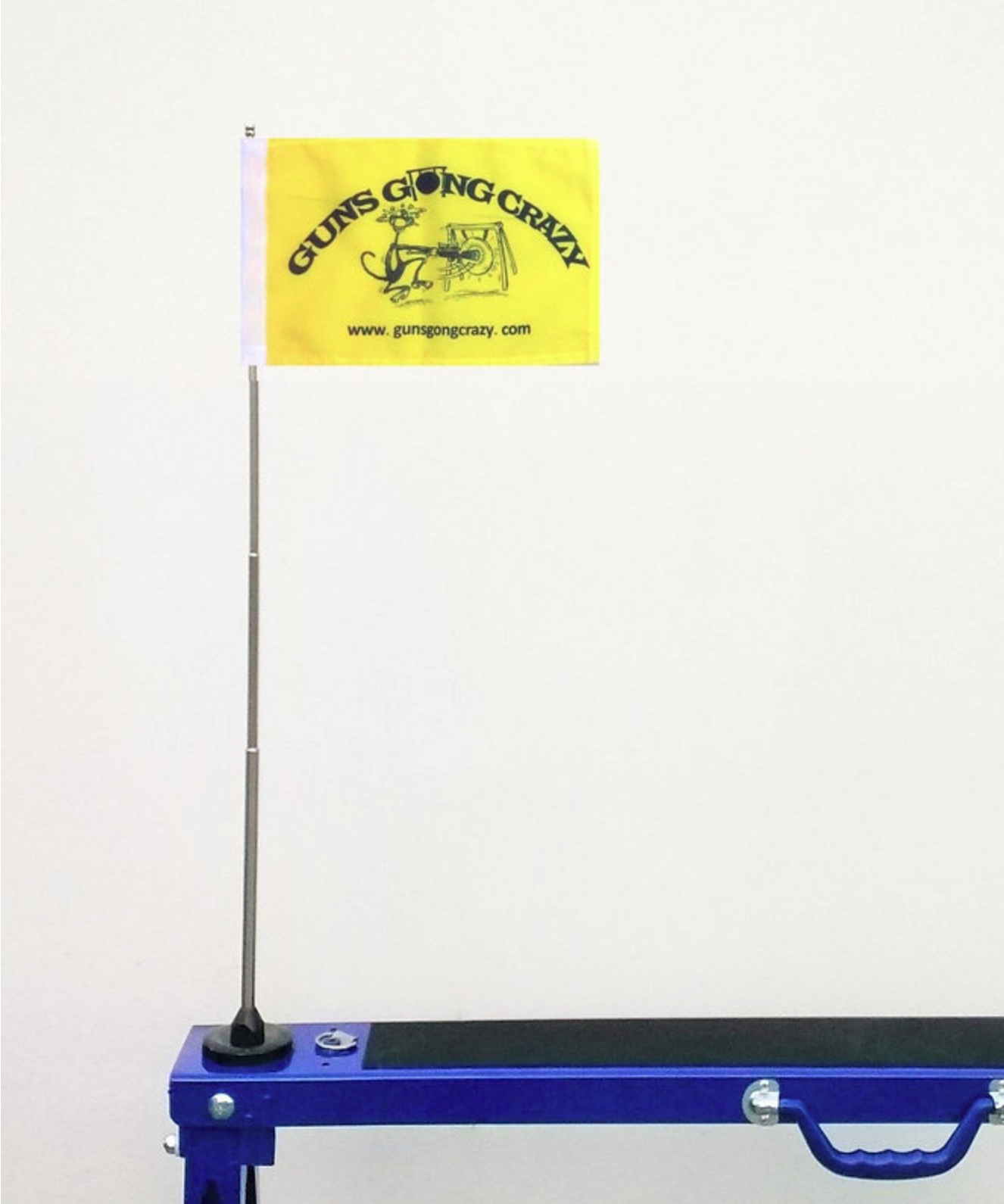
The Guns Gong Crazy Wind Antenna and Flag Kit was designed to meet exactly those criteria for use with our AR500 target systems. The kit uses a telescoping antenna that collapses small enough to store with the rest of your target components and deploys to full height without any tools or separate hardware. The magnetic base locks onto the steel components of the target stand in seconds, so there is no separate ground spike to drive, no clamp to find, and no fumbling around when you are setting up in the field.
The flag material itself is sized to be clearly visible from many shooting positions, which covers the distance range where wind reading is immediately useful for steel gong target work. At pistol distances inside 25 yards, wind drift is essentially irrelevant and the flag is not doing meaningful work for you. At rifle distances where wind actually affects your shot outcome, the flag reads cleanly from the firing line.
Mounting the flag kit takes under a minute as part of your standard target setup process. Extend the antenna to the desired height, attach the magnetic base to the stand, orient the flag arm perpendicular to your line of fire, and walk back to the firing line. From that point forward the flag is working for you on every shot without any additional attention or adjustment.
What a Flag Cannot Tell You, and What to Do About It
A wind flag at the target is a genuinely useful tool and one we strongly recommend as a
standard part of any AR500 steel gong target kit used at rifle distances. But being honest about its limitations is part of using it correctly.
A single flag at the target does not give you information about wind conditions in the midrange: the air your bullet is flying through at the halfway point of its flight. In most practical steel gong shooting setups, this is an acceptable limitation. The target wind is the most actionable data point, and the midrange wind is very difficult to observe without additional flags along the entire range length. For recreational steel target work, what you gain from a single target flag is enough to meaningfully improve your wind reading and your hit percentage at rifle distances.
A flag also cannot tell you about vertical wind components that might be deflecting your bullet up or down. This is an extremely rare concern at typical steel gong target distances and is essentially irrelevant below 500 yards in normal shooting conditions.
What a flag does tell you is direction, approximate speed, and consistency. Those three data points are the foundation of every practical wind call at the distances you are shooting steel gongs. Combined with knowing your bullet's drift at common distances and wind speeds, which you can calculate in advance and write on a range card or commit to memory for your primary cartridge, the flag gives you everything you need to call the wind confidently and hold the right amount.
Getting Started with Wind Reading
If wind reading feels like a skill reserved for competition shooters or hunters making extreme range shots, it is worth pushing back on that assumption. The fundamentals: reading flag angle for speed, reading flag direction for full versus half versus no value, and holding the appropriate amount into the wind are learnable in a single afternoon. You do not need a background in ballistics or competitive shooting. You need a basic understanding of the principles, a flag downrange showing you live conditions, and a willingness to think about what the wind is doing before you pull the trigger instead of after.
Start by spending five minutes watching the flag at your target position before your first shot of the session. Get a sense of the average condition, the direction it mostly points and the typical angle it flies at. Call an approximate wind speed based on that angle. Pick a direction adjustment based on where the flag is pointing relative to your line of fire. Then shoot, and pay attention to whether your hit location reflects the wind call you made. Over the course of a session, this deliberate observation builds until it becomes an automatic part of how you set up every shot at distance.
That process: observe the flag, make a call, fire, observe the result is a feedback loop that makes you a better shooter every time you complete it. It works because you are converting what would otherwise be unexplained variance, shots that hit and shots that miss for reasons you cannot identify, into an understandable system where you know the inputs and can correct them.
The steel gong is still ringing at the end of that process. It just rings a lot more often than it did before you started reading the wind.
Why It Is Worth Adding to Your Kit Now
The case for a wind flag comes down to something simple. Every time you shoot steel gong targets at rifle distances without a downrange wind indicator, you are missing a piece of information that affects nearly every shot in variable conditions. Sometimes the wind is negligible and that missing information does not matter. But on most range days at most outdoor locations, wind is a real variable, and shooting without any information about it means accepting that you cannot fully diagnose your own performance.
Adding a wind flag changes that. It is the lowest cost, fastest setup piece of information-gathering equipment you can add to a steel gong target system, and it is the one piece of additional gear that has the most direct effect on the quality and productivity of your
range sessions at rifle distances.
When you are in the middle of a session, shooting steel at 200 and 300 yards, and you glance downrange and see the flag tell you the wind shifted from half value to full value between your last shot and this one, you have a real time edge. You make the adjustment. You pull the trigger with confidence because you know what the conditions are. You hear the ring.
That is what a wind flag does. It turns a variable you were ignoring into a variable you are managing. And in shooting, managing your variables is how you get better.
Pick one up with your next order, mount it alongside your AR500 gong on the next range day, and give yourself five minutes to watch it before your first shot. You will not set up a rifle distance steel gong range without it again.
Shoot straight, shoot smart, and hear that ring.