
Why the Angle of Your Steel Gong Target Is Not Optional
Why the Angle of Your Steel Gong Target
Is Not Optional
Most shooters spend a lot of time thinking about their ammunition, their optics, and their
distance from the target. Almost nobody spends any time thinking about the angle of the target itself. That is a problem, and depending on your setup, it might be a bigger one than you realize.
Target angle is not a fine-tuning detail you revisit after you have everything else dialed in. It is foundational to how a steel gong system is supposed to work. Get it wrong and the physics work against you. Get it right and every round you send downrange is handled the way it was designed to be handled. The good news is that once you understand what is actually happening at the moment of impact, the right answer becomes pretty obvious.
What Actually Happens When a Bullet Hits Steel
Here is something most people have never thought about: a bullet does not simply stop when it hits an AR500 steel target.
At rifle velocities, the bullet deforms and fragments almost instantly, releasing a significant amount of kinetic energy in a very short window of time. That energy has to go somewhere. On a target hanging flat and perpendicular to the shooter, a meaningful portion of that energy and the fragmented material carrying it has a direct path back toward the firing line. Not always dangerously so, but the geometry is not working in your favor.
Now tilt the top of that same target back away from you. Suddenly the physics change. The fragmented material has a deflection path that sends it toward the ground instead of back the way it came. Think about how a ramp works, or a wedge, or any surface that redirects force by changing the angle of contact. A target hung at the right tilt uses the bullet's own energy to send the fragments down into the dirt. That is not a marginal improvement over hanging it flat. It is the entire ballgame when it comes to managing fragmentation safely.
The Heat Problem Nobody Talks About
Here is a second reason target angle matters, and this one has nothing to do with safety. It has to do with how long your target actually lasts.
When a bullet fragments against steel, the impact generates a serious amount of localized heat. That heat transfers into the plate at the point of contact. On a target hanging flat, that heat concentrates directly at the face of the steel and stays there. Over hundreds of rounds across many sessions, repeated thermal stress in the same zone starts to show up as pitting and eventually cratering on the face of the plate.
When a target is hung at the correct downward angle, the deflection that protects the shooter also changes how that energy distributes across the steel face. The target takes less direct punishment per hit, and over the life of the system that difference adds up to significantly more service time before anything needs to be replaced.
Shooting steel is an investment. Hanging it at the right angle is how you protect that investment.
What the Right Angle Actually Looks Like
The standard recommendation across the steel target industry is a minimum downward tilt of around 20 degrees, meaning the top of the target leans back away from the shooter. That number is not arbitrary. It reflects the geometry needed to reliably redirect fragmented material toward the ground at the distances and velocities typical for rifle shooting.
A lot of shooters try to approximate this with improvised setups: nudging a chain-hung target by hand, draping it over a tree limb at a lean, eyeballing the tilt before a session. The problem with all of those approaches is consistency. An angle that looks about right from behind the firing line can be meaningfully different from the correct geometry at the target face, and small deviations in tilt can have larger-than-expected effects on where fragmented material travels.
The other problem is that improvised angles do not hold. A target that starts the session at the right tilt will shift over the course of the day as the hardware settles, as the ground shifts under the stand, or as the impacts themselves slowly nudge the geometry in the wrong direction. You set it up right and an hour later it is flat again, and you never noticed.
How Our System Takes Guesswork Out of It
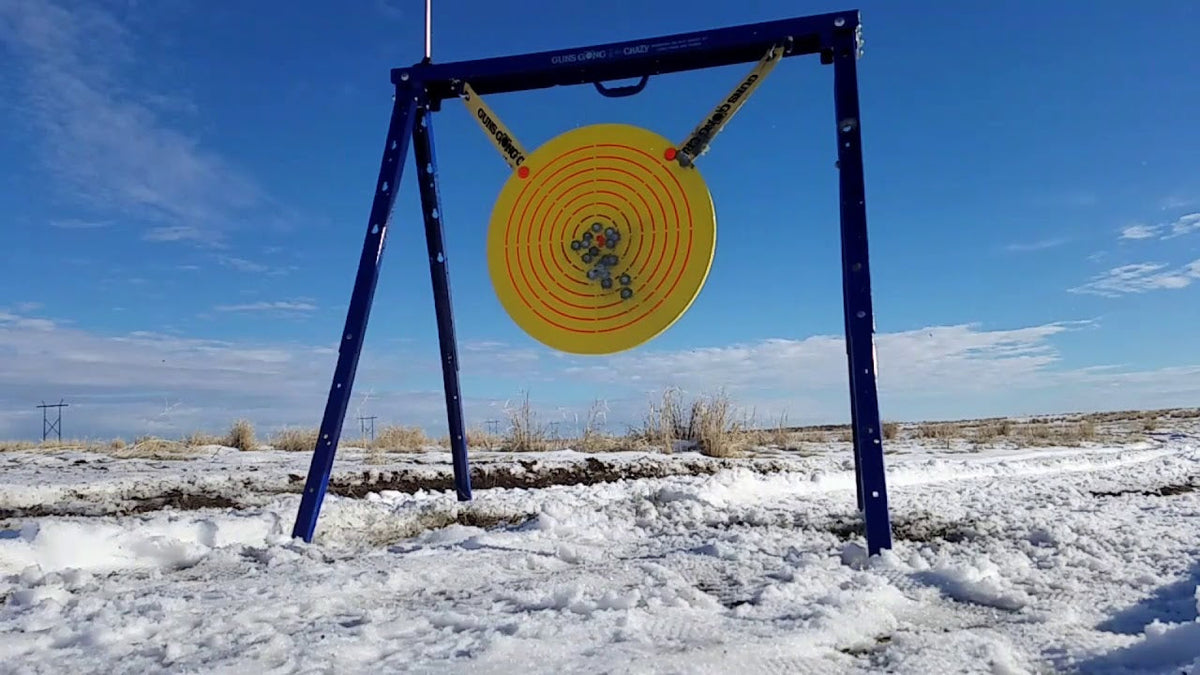
The Guns Gong Crazy target system is engineered so that the correct hanging angle is a built-in result of the hardware rather than something you have to dial in manually.
The stainless steel bolt plate hardware and Kevlar strap configuration positions the gong at the appropriate downward tilt by default. When you assemble the system and hang it the way it is designed to be hung, the target face is already oriented to deflect toward the ground. There is no angle to set, no lean to eyeball, and nothing to readjust mid-session.
That matters more than it sounds. On a system where angle depends on improvisation, the safety and wear benefits are only present when your improvisation happens to be right that day. On a system where the angle is a function of the hardware itself, those benefits are present automatically, every session, for the entire life of the target.
The Kevlar straps reinforce this in a second way. Because Kevlar does not stretch, deform, orfatigue the way chain or rubber does over time, the geometry you assemble is the geometry that holds. Chain loosens. Rubber wears. Kevlar holds. The angle your target hangs at on the hundredth range day is the same angle it hung at on the first one.
A Note on Terrain and Height
Even with a well-designed hanging system, a couple of terrain variables are worth thinking about when you set up.
The ideal scenario is shooting at a slightly downward angle toward the target rather than uphill or on perfectly level ground. When you are positioned even a little higher than the target, the natural trajectory of deflected material is even more pronounced toward the ground. Flat ground is fine, the engineered angle handles it, but if you have a choice of where to put the target relative to your shooting position, lower is better.
Target height matters too. A gong mounted too high forces you into a shooting angle that partially cancels the benefit of the downward tilt. Keep the center of the target at roughly the same height as your shooting position or lower, and try to stay at or below four feet from the ground for most setups. Lower mounting height combined with correct tilt gives you the most favorable fragmentation geometry you can get.
Why This Does Not Get More Attention
Target angle is the kind of thing that seems obvious the moment someone explains it and
completely invisible until they do. Most people hang a steel gong, confirm it is not going to fall over, and start shooting. The tilt of the face is not something that announces itself as a variable. It just quietly works for you or against you depending on whether your setup happens to be right.
The shooters who understand this usually got there one of three ways: a safety incident, a target that showed unusual cratering from being shot flat for too long, or someone who knew the physics taking the time to walk them through it. This article is meant to be that third path beforecthe other two occur.
Steel gong shooting is one of the most satisfying ways to spend a range day. The feedback is immediate, the challenge scales with distance and caliber, and a well-maintained system will outlast almost any other range investment you can make. Getting the most out of it starts with understanding how the system is designed to function, and that design starts with the angle. Set it up right. Let the physics do their job. Then pull the trigger and hear that ring.