AR500 Steel Gong Target Safe Shooting Distances: The Complete Caliber Guide
There is a question that comes up at nearly every range day, whether you are shooting with a group of friends out in the Idaho high desert or setting up solo on a piece of private land. Someone looks at the steel gong hanging from the stand, looks back at the firing line, and asks some version of the same thing: how far back do we need to be?
It’s a great question. It’s actually one of the most important questions you can ask before you put a single round downrange at a steel target. And the honest answer is that it depends on what you are shooting, how fast it’s moving, and what your target is made of. There is no single universal distance that covers every situation, which is why so many shooters either play it too conservative and miss out on some fun close range pistol work, or play it too aggressive and end up with a broken gong or injured.
This guide will give you the complete picture. We will walk through safe shooting distances for every major caliber category, explain the physics behind why those distances exist, cover the specific considerations for a portable AR500 steel gong target setup like the ones we build here at Guns Gong Crazy, and make sure you leave with a clear, confident understanding of how to set up your range day safely every single time.
Why Distance Is the Single Most Important Safety Variable When Shooting Steel
Before we get into the numbers, it is worth understanding why distance matters when you are shooting at a steel target. This is not an arbitrary rule somebody invented. It is physics, and once you understand what is actually happening in those fractions of a second after a bullet hits steel, the distance guidelines will make sense to you.
When a bullet traveling at high velocity strikes a hardened AR500 steel gong target, the projectile does not simply stop. The bullet itself fragments into small pieces of jacket material and lead, and those fragments travel outward from the face of the plate in a spray pattern. The angle of that spray is influenced by the angle of the target, the hardness of the steel, the construction of the bullet, and the velocity at impact.
Here is the key variable that distance controls: the energy those fragments carry. At the moment of impact, even small fragments are traveling fast enough to cause injury. But fragments lose energy quickly as they travel through the air. At proper shooting distances, the fragments that reach the shooter have bled off enough energy to be harmless, maybe a light sting at worst. At improper distances, those same fragments can retain enough velocity to cause serious injury, particularly to exposed skin, hands, and most critically, unprotected eyes.
This is also why target angle matters so much alongside distance, a point we will come back to throughout this guide. A steel gong target angled a few degrees forward (built into our systems), face tilting slightly down toward the ground, directs the bulk of the fragmentation pattern downward rather than outward. Distance and angle work together. Get both right and your range days stay safe and enjoyable.
What Makes AR500 Steel Different from Regular Steel for This Equation
Not all steel targets behave the same way, and the grade of steel your gong is made from directly affects what safe shooting distances look like in practice.
AR500 is a specific designation for abrasion resistant steel with a Brinell hardness rating of approximately 500. This level of hardness is what allows the target to resist deformation and pitting under repeated bullet impacts. When a bullet hits AR500 steel, the target surface destroys the projectile on impact rather than allowing it to penetrate or deform the plate in ways that create more dangerous fragment patterns.
Softer steel targets, the kind you find in bargain bins or questionable online listings, behave very differently. A softer plate can develop pits and divots over time, and once those surface irregularities exist, bullet fragmentation patterns become unpredictable. Fragments can be redirected at angles that no distance guideline can fully account for.
This is why the safe shooting distances in this guide assume you are working with a properly rated AR500 steel gong target. If you are working with an unknown steel grade or a plate that has developed visible pitting and surface damage, the appropriate response is to increase your distance significantly or retire the target entirely. Damaged steel does not play by the same rules as a fresh, properly hardened plate.
Safe Shooting Distances for Handguns
Handguns are where most people start with steel target shooting, and for good reason. The combination of manageable recoil, fast follow up shots, and the satisfying ring of a well placed hit on steel makes for an incredibly fun and effective training session. The good news on distances is that handguns offer the most flexibility of any firearm category when it comes to how close you can work.
For standard centerfire pistol calibers including 9mm, .40 S&W, and .45 ACP with standard pressure ammunition, the widely accepted minimum safe shooting distance for an AR500 steel gong target is 10 yards. This is the distance used by IDPA in competition settings and reflects what the physics actually support with properly hardened steel, correct target angle, and standard jacketed or hollow point ammunition.
That said, 10 yards is a minimum, not a recommendation for all shooters and all situations. If you are newer to steel target shooting, starting at 15 to 20 yards and working your way closer as you get comfortable with your setup is a smart approach. The feedback from steel at 15 yards is just as immediate and satisfying as at 10 yards, and the additional distance gives you more margin while you dial in your positioning.
For magnum pistol calibers, meaning .357 Magnum, .44 Magnum, and similar high pressure, high velocity handgun rounds, you want to back that minimum up to 15 to 20 yards. These rounds are moving significantly faster than standard pressure cartridges, and the higher impact velocity means fragments carry more energy at the moment of dispersion. The physics demand a bit more distance to let that energy dissipate to safe levels.
For .357 Sig and 10mm Auto, which combine pistol platform with relatively high velocities, treating them more like the magnum category and maintaining 15 yards as your minimum is the correct call.
One important note on rimfire pistols and .22 LR at handgun distances: you can safely work closer with .22 LR from a pistol, as close as 7 to 10 yards on a properly rated AR500 target, because the lower velocity and lower energy of rimfire ammunition means fragments are carrying very little energy at the point of dispersion. Rimfire from a pistol at 10 yards on AR500 steel is about as low risk a steel shooting scenario as exists.
Safe Shooting Distances for Shotguns
Shotguns present their own set of considerations because the projectile situation is fundamentally different from rifle and pistol shooting. You are not sending a single jacketed bullet downrange. You are sending either a single large slug or a pattern of multiple pellets, and each of those scenarios behaves differently on impact with steel.
For birdshot and smaller shot sizes used in clay shooting and light game loads, the low individual pellet mass means energy per fragment is relatively low. A minimum of 20 to 25 yards is appropriate for these loads on AR500 steel gong targets, and the fragmentation patterns are generally quite manageable at that distance.
For buckshot, particularly 00 buck and larger, each individual pellet carries considerably more energy than a birdshot pellet. Each one of those pellets is essentially a small projectile with its own fragment pattern at impact. For buckshot loads, 25 yards is the minimum distance you want to maintain, and moving toward 30 to 35 yards gives you additional margin.
For rifled slugs, which are the heaviest and fastest projectile you will fire from a shotgun, the safe minimum distance on AR500 steel is 50 yards. A full ounce of lead or the equivalent in a sabot slug traveling at 1,300 to 1,500 feet per second carries an enormous amount of energy, and the fragment pattern on steel impact reflects that. Keep at least 50 yards between yourself and the target when running slugs, and make sure your target is properly angled forward to direct the dispersion toward the ground.
Safe Shooting Distances for Rifles: The Category That Matters Most
Rifle calibers are where the distance conversation becomes most serious, and where the most common mistakes happen. The velocity and energy levels involved in rifle shooting are in a completely different category from pistols and shotguns, and the safe shooting distances reflect that directly.
The standard guidance you will hear repeated across the shooting community is that 100 yards is the minimum safe distance for shooting an AR500 steel gong target with a rifle. That baseline holds for a wide range of common rifle calibers and is a solid starting point for anyone setting up a portable steel target range for the first time.
But the 100 yard baseline is not the whole story, and understanding where it comes from and where it has exceptions will make you a smarter and safer shooter.
Intermediate Rifle Calibers: 5.56 NATO and .223 Remington
5.56 NATO and its civilian cousin .223 Remington are among the most commonly fired rifle calibers in the United States, and they are also among the calibers where people most frequently make distance mistakes with steel targets. The high velocity of these rounds, typically between 2,700 and 3,100 feet per second depending on barrel length and load, combined with the relatively light bullet weight, creates a specific impact characteristic that demands respect.
At 100 yards, 5.56 NATO fired at a properly rated 3/8 inch AR500 steel gong target is within the safe operating parameters for the target and for shooter safety. The bullet is moving fast but the impact energy has stayed within a range that the steel handles cleanly.
The critical thing to know about 5.56 and steel core or penetrator ammunition, specifically the M855 green tip load, is that this ammo behaves differently on steel than standard lead core projectiles. The steel penetrator in M855 can cause more aggressive pitting and surface damage to AR500 targets at closer ranges and does not fragment as cleanly. If you are running M855 or any steel core 5.56 ammunition, hold 125 yards as your minimum distance and consider upgrading to AR550 steel if you plan to shoot this ammo regularly.
For standard 5.56 and .223 loads with lead core bullets at 100 yards on properly rated AR500, you are in good shape. For anything with a steel core penetrator, step back to 125 yards minimum.
The .308 Winchester and 7.62x51mm NATO
The .308 Winchester is the benchmark rifle cartridge for a reason. It is accurate, effective at long range, and used by everyone from deer hunters to precision shooters to military and law enforcement. It is also a round that brings serious energy to the impact equation with a steel target.
A standard .308 load pushing a 168 grain bullet at 2,650 feet per second carries over 2,600 foot pounds of energy at the muzzle, and even at 100 yards that number is still substantial. For AR500 steel gong targets, 100 yards is the accepted minimum for .308 and 7.62x51mm, and it works well when the target is properly rated at 3/8 inch thickness or greater and correctly angled.
For precision rifle shooters who run .308 at longer distances, which is very common for this cartridge, the safe distance question takes care of itself because you are naturally operating well beyond the 100 yard minimum. At 300, 400, and 500 yards with .308, you are not just within safe distance parameters but in the sweet spot where this round truly excels on steel gongs.
One consideration with .308 at closer ranges near the 100 yard minimum is bullet construction. Heavier match bullets with premium construction will generally fragment more cleanly on AR500 steel than lighter or cheaper hunting bullets that may have softer cores. This is not a reason to shoot .308 inside 100 yards, but it is worth knowing that not all .308 ammo interacts with steel identically.
Common Hunting Rifle Calibers: .30-06, .270, .243, and 6.5 Creedmoor
The hunting rifle caliber family includes a range of cartridges with varying velocity and energy profiles, and they all deserve consideration when you are setting up a steel gong target for a pre season practice session or year round range work.
For .30-06 Springfield, which pushes a 150 to 180 grain bullet at 2,700 to 2,900 feet per second, the safe minimum distance on AR500 steel is 100 yards, the same as .308. The energy profile is similar and the interaction with hardened steel is comparable.
For .270 Winchester with its high velocity lightweight bullets, often moving at 3,000 feet per second or faster, 100 yards is the minimum and erring toward 125 yards is a good habit given the elevated velocity. High velocity lighter bullets can behave more aggressively on steel than slower, heavier bullets with similar energy.
For .243 Winchester and 6mm Creedmoor, which use lighter bullets at very high velocities often exceeding 3,000 feet per second, the velocity factor again recommends 100 yards as a firm minimum with 125 yards as the better practice distance.
For 6.5 Creedmoor, which has become one of the most popular precision rifle cartridges in the country and for good reason, 100 yards is the appropriate minimum on 3/8 inch AR500 steel. The 6.5 Creedmoor’s combination of moderate velocity and excellent long range performance makes it a natural fit for steel gong shooting at 200, 300, and beyond, where it absolutely excels.
Magnum Rifle Calibers: .300 Win Mag, 7mm Rem Mag, and Similar
Magnum rifle calibers bring a meaningful step up in both velocity and energy compared to standard rifle cartridges, and safe shooting distances for steel targets reflect that.
For .300 Winchester Magnum pushing 180 grain bullets at 2,950 feet per second and generating over 3,500 foot pounds of energy at the muzzle, the minimum safe distance on AR500 steel gong targets is 125 yards. This extra distance over the standard 100 yard rifle baseline accounts for the significantly higher impact energy these cartridges deliver.
For 7mm Remington Magnum, .300 WSM, and similar magnum cartridges in the same energy class, 125 yards is the right call as a minimum. Many shooters running these cartridges on portable steel gong setups are doing so at 200 to 500 yards anyway, which puts them within safe distance parameters naturally.
One thing worth noting for anyone hunting with magnum rifle calibers who also wants to use steel gong targets for pre season practice: the extra distance requirement is not a problem in any typical field shooting scenario. You are not going to be practicing your 300 yard elk shot from 80 yards. The distance requirements for magnum cartridges align naturally with the distances at which you would actually be using them in the field.
The .50 BMG and Other Extreme Calibers
The .50 BMG occupies a special category when it comes to steel target shooting, and if you are shooting this round you almost certainly already know that the rules are different. For AR500 steel gong targets, the .50 BMG requires a minimum distance of 400 yards, and many target manufacturers will specify that .50 BMG should only be used on half inch AR500 or thicker, not the 3/8 inch plates that handle most rifle calibers comfortably.
The energy involved in a .50 BMG impact, over 13,000 foot pounds at the muzzle, is simply in a different category from anything else on this list. The fragmentation pattern and the forces on the target and hanging system are extreme. If you are a .50 BMG shooter looking to use steel gong targets, 400 yards minimum and AR550 or half inch AR500 are the baseline requirements.
For other large magnum cartridges in the energy neighborhood of .338 Lapua Magnum and .338-378 Weatherby, 200 yards is the appropriate minimum on 3/8 inch AR500, and upgrading to half inch plate or AR550 is worth considering if you plan to shoot these rounds on steel regularly.
How Target Angle Changes the Distance Equation
We have mentioned target angle throughout this guide and it is worth addressing it specifically because it interacts directly with every distance guideline we have covered. The angle of your steel gong target is not just a setup preference. It is a safety mechanism that works alongside distance to control where fragmentation travels after impact.
A properly hung AR500 steel gong target should have the face angled three to five degrees forward, meaning the top of the target leans slightly toward the shooter and the bottom leans slightly away. This geometry directs the bulk of bullet fragmentation downward toward the ground in front of the target rather than outward and toward the shooter.
When a target is hung perfectly vertical, with no forward lean, fragmentation can travel in a much wider pattern including back toward the shooter. When a target is over angled, leaning too far forward, it changes the ricochet geometry in ways that can be equally unpredictable.
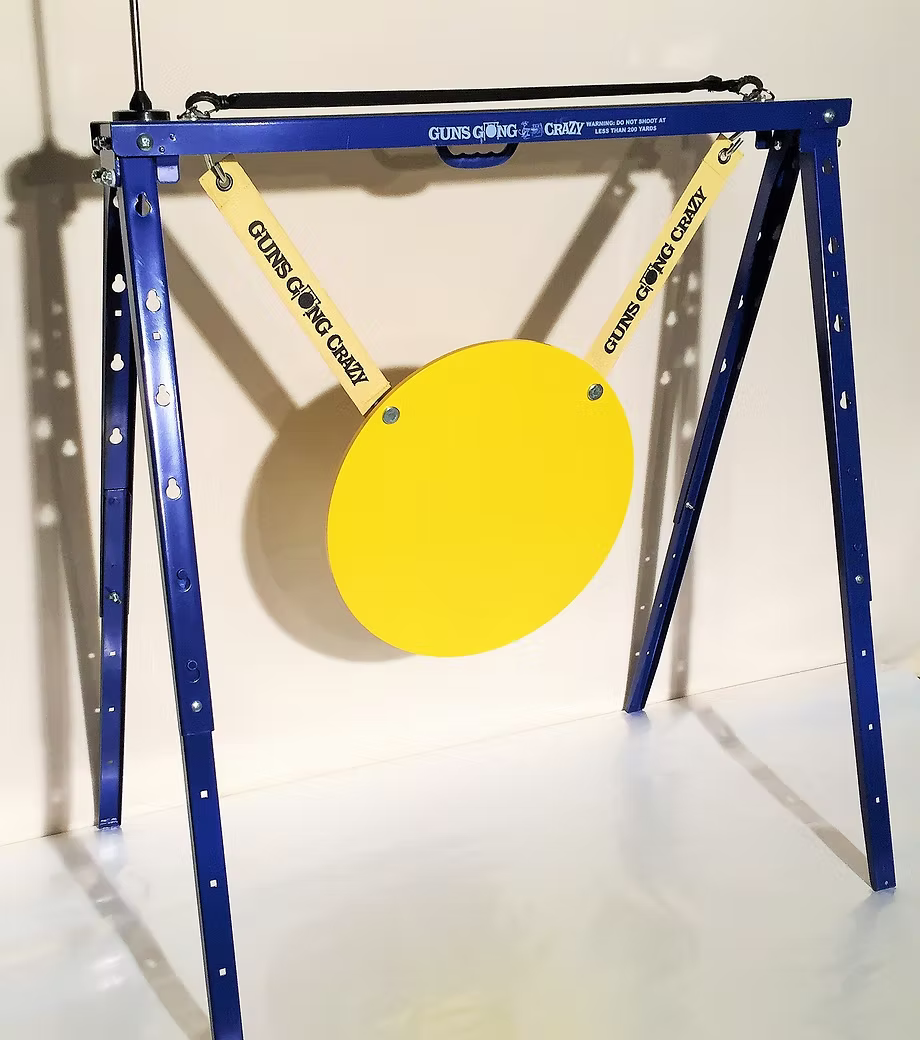
Three to five degrees of forward lean is the sweet spot. On a Guns Gong Crazy AR500 Target System with the adjustable stand, Kevlar straps, and angled brackets, dialing in this angle is straightforward because the system is designed to hold this geometry consistently. It is one of the things a purpose built portable steel gong target system does better than a homemade chain and post setup, where controlling the hang angle precisely is much harder.
Ammunition Type and How It Affects Safe Distance
Caliber alone is not the complete picture when setting your shooting distance. The construction of the bullet you are loading into your firearm has a meaningful effect on how safely a given distance performs.
Standard copper jacketed lead core bullets, which is what the vast majority of range ammunition consists of, fragment in the most predictable and manageable way on AR500 steel. The copper jacket peels away and the lead core mushrooms and breaks apart, distributing energy across a fragmentation pattern that the distance guidelines in this guide account for.
Hollow point pistol ammunition, including the defensive loads most people carry in their personal protection firearms, generally fragments at least as cleanly as ball ammunition and often more so. There is no reason to avoid hollow points on steel at appropriate distances.
Steel core and armor piercing ammunition is a different story entirely. Any ammunition with a steel penetrator or hardened core interacts with AR500 steel in ways that can cause more aggressive pitting, less predictable fragmentation, and higher risk of ricochet. This includes M855 green tip 5.56, 7.62x39mm steel core AK ammunition, and any load specifically designed to penetrate hardened surfaces. Add 30 yards to whatever the standard minimum distance is for that caliber when running steel core ammo, and be aware that over time this ammunition type will damage your target faster than standard lead core loads.
Frangible ammunition, which is designed to break apart completely on hard surfaces, is in some ways the most steel target friendly ammunition type that exists. Frangible rounds reduce the risk of ricochet significantly because there is no intact projectile to redirect, only fine powder. On AR500 steel at appropriate distances, frangible ammunition can allow you to work slightly closer than the standard minimums with greater safety margin, which is why law enforcement trainers often use it for close range steel work.
Setting Up Your Portable AR500 Steel Gong Target System for Safe Shooting
Understanding the distance guidelines is one thing. Setting up your actual range day correctly so those guidelines translate into real world safety is where it all comes together.
When you set up a portable AR500 steel gong target system in the field, the process should start with identifying your firing line based on what calibers you plan to shoot that day. If you are running a mixed-caliber session with both pistols and rifles, your firing line distance is set by the rifle minimum, which for standard calibers means 100 yards. Your pistol shooting will happen from that same line, which puts you well beyond the pistol minimum and is completely fine.
The next step is getting your target hang angle right before the first shot goes downrange. Adjust the stand height and the Kevlar strap configuration so the face of the gong has that three to five degree forward lean. Check it by eye from the side of the target before you walk back to the firing line. Use our Kevlar hanging system for built in hardware that places your target forward for an easy setup.
Inspect your Kevlar straps and hardware before every session. A properly hung target on properly maintained straps behaves predictably. A target with worn hardware or a loose hang can shift under impact and change the angle in ways that affect the fragmentation pattern.
Make sure everyone at your range session is wearing appropriate eye protection before the first round goes downrange. This is not optional and it is not excessive caution. The overwhelming majority of steel shooting injuries involve eyes, and certified ballistic eye protection eliminates that risk almost entirely. Make it as automatic as putting on ear protection.
Finally, if you are ever in any doubt about whether your distance is adequate for a particular load, back up. The range day is still going to be fun at 150 yards instead of 100 yards. The ring of AR500 steel carries just fine at distance. There is no shot worth taking at an uncertain distance.
A Quick Reference Guide by Caliber Category
Rather than hunting back through the article every time you need a quick answer, here is the distilled version of everything we have covered. These are the minimum safe shooting distances for an AR500 steel gong target with proper target angle and standard lead core ammunition.
For rimfire cartridges including .22 LR and .17 HMR from any platform, the minimum is 25 yards. For standard pressure centerfire pistol calibers including 9mm, .40 S&W, and .45 ACP, the minimum is 10 yards with 15 yards as the better starting point. For magnum pistol calibers including .357 Magnum, .44 Magnum, and 10mm, the minimum is 15 to 20 yards.
For shotgun birdshot and light loads the minimum is 25 yards. For buckshot the minimum is 25 to 30 yards. For rifled slugs the minimum is 50 yards.
For intermediate rifle calibers including 5.56 NATO and .223 Remington with standard lead core ammo the minimum is 100 yards. For steel core 5.56 and M855 the minimum is 125 yards. For .308 Winchester, .30-06, 6.5 Creedmoor, and similar standard rifle cartridges the minimum is 100 yards. For high velocity cartridges including .270 Winchester and .243 Winchester the minimum is 100 yards with 125 yards as the better practice. For magnum rifle calibers including .300 Win Mag and 7mm Rem Mag the minimum is 125 yards. For .338 Lapua and similar large magnums the minimum is 200 yards. For .50 BMG on half inch AR500 or AR550 the minimum is 400 yards.
When in doubt, add distance. The ring of steel sounds just as good at 150 yards as it does at 100. It sounds a lot better than a trip to the first aid kit or worse.
Why a Purpose Built Portable System Makes All of This Easier
Everything in this guide assumes your steel gong target is properly set up, correctly angled, and hanging securely on hardware designed for this application. That assumption is easy to meet with a purpose built portable AR500 target system. It is much harder to guarantee with improvised setups using whatever T-posts and hardware you had in the truck.
The Guns Gong Crazy AR500 Target System was designed from the ground up to make correct setup fast, repeatable, and reliable. The adjustable stand lets you set the target height and angle correctly in minutes rather than wrestling with improvised solutions. The Kevlar strap hanging system holds the hang angle consistently from the first shot to the last, without the creep and shift that chain systems develop over the course of a session.
When your target is set up correctly every time, the distance guidelines in this guide work as intended. When your setup is inconsistent, no distance guideline can fully account for what happens at impact. A system that is easy to set up correctly is a safety feature in itself, because it removes the temptation to take shortcuts when you are eager to start shooting.
If you are ready to set up a portable steel gong target range that is safe, reliable, and genuinely fun to shoot at every caliber and every distance covered in this guide, the AR500 Target System is where to start.
Shoot straight, shoot safe, and hear that ring.